
SECOND-HAND SMOKE AMONG UNIVERSITY STUDENTS:EXTERNAL COSTS OF A HARMFUL HABIT
By
Gabriel Leandro, MBA
Economist
The different activities that people and enterprises carry out imply several private costs and in some cases external costs thus private costs and social costs are not always equal. An example of such situation can be a cement manufacturer located near a residential area. In this case the private costs imply work force, materials, depreciation, rent, etc. This manufacturer aims to increase his benefits, when his marginal-revenue equals his marginal private cost but this decision may not be economically efficient if the external costs or externalities that this activity causes to other people and firms are not taken into consideration.
An externality is defined as the effect of economic activities of one party to another party, that the price system does not consider (Nicholson). Externalities occur when private costs and social costs are not equal. Externalities can be either positive or negative. In this way, the cement manufacturer for example when he does not take into account all the pollution resulting from his activity and how it affects the near areas or other near manufacturers, he is creating a situation in which the social cost is greater than the private cost.
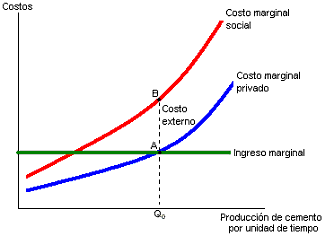
In the graph, we can observe the marginal private cost. Under the supposition that the manufacturer participates in a competitive market, he would produce the amount Qo (of cement) per unit of time, because that is the point where he increases the profits, but at such level of production we can clearly observe that the marginal cost is higher as a consequence of the cost that implies pollution. At the level of production Qo the external cost is represented by the distance from A to B.
In this example of the manufacturer of cement, the problem basically consists in how to achieve the best use of the air, which represents a resource that lacks of property rights (perceiving this right as the legal one that determines who owns a good and how that good is used) because nobody owns the air.
To many the solution should be to eliminate pollution completely which would probably imply to close this cement industry. However, this would not be the best solution because the same houses that have been affected by this industry have been favoured by it in the sense that they were built with the material produced by it (cement). Therefore, it is not efficient either to eliminate pollution completely but to find an appropriate or acceptable level of pollution.
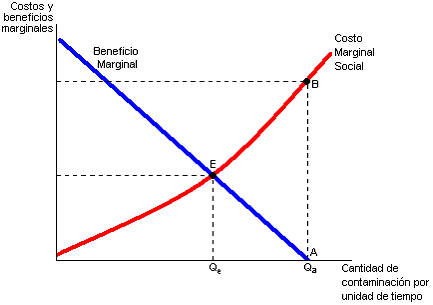
According to the last graph, the cement producer maximizes his benefits in point A, with the amount Qa of pollution where his marginal profit is zero (in other words his marginal cost and his marginal revenue are not equal) At this level of production, the marginal social cost is represented by the distance form A to B, resulting in an inefficient outcome because the marginal social cost is greater than the marginal profit. At the level of pollution Qe, the marginal social cost and the marginal profit are equal therefore it would be a level of efficient pollution.
For an outcome like the previous one to have effect it is required any kind of property right over air that encourages any agreement between the neighbourhood and the factory which may indemnify them for the pollution caused or provide any other solution. However, such agreement would be possible to reach because it implies huge costs. For this reason, governments set regulations, pollution charges, permissions and taxes which represent methods to achieve the outcome previously explained if they are implemented in the right way.
SMOKING: A CASE OF SIMILAR OR WORSE EXTERNAL COSTS THAN THE ONES OF THE CEMENT INDUSTRY
According data from Caja Costarricense de Seguro Social, smoking causes 67% of the cancer deaths, 50% of respiratory diseases, 15% of the diseases of the circulation system and 10% of the newborn deaths. In addition to the negative consequences of smoking to the smoker, there are a number of external costs related to discomfort, irritation, and damages to the health of people around them, I mean the passive smokers.
Tobacco consumption, passive smoking or involuntary smoking is considered the main cause of premature death in the world. To The United Nations Children’s Fund (UNICEF), the activities of the tobacco industry could lead to a worldwide catastrophe regarding health especially among children and women. Tobacco represents a big treat to the rights of children because it not only brings about diseases like asthma and congenital defects but also due to it maybe parents do not have enough money to pay the education of their children and medical assistance since they spend money in cigarettes. (Carol Bellamy, Executive Director of UNICEF).
According to a web page of IAFA related to programs against smoking, in Costa Rica the passive smoking is responsible for a number of children diseases every year: 27000 cases of otitis, 46000 visits to clinics and hospitals due to cough, new 9 cases of asthma, 10 asthma attacks, 11 cases of bronchitis and pneumonia and 4 ear and tonsil surgery. This mean that in Costa Rica around 100000 children examinations take place per year due to the negative effects of adult smoking on children in addition to 20 hospitalizations at a cost of six hundred millions of colones per year.
According to the economic theory and as it was explained in the example of the cement manufacturer, smokers and non smokers are trying to use the same good, air, which does not belong to any of them. The discomfort that the smokers cause to non smokers is an example of an externality therefore smokers should be indemnified in some way or there should be some agreement or regulation that avoid such situation. On that score, there are some solutions.
- Private agreements: due to the difficulty of setting property right over air in addition to the reciprocal nature of the externalities (to the smoker the non smoker represent a discomfort too, because the non smokers prevent the smoker from enjoying smoking) an agreement between them represents a feasible solution in some cases mainly when a third party establishes the agreement. For example, restaurants have the smoking area and the non smoking area.
- Smoking prohibition: the government as well as public institutions establish norms to prohibit smoking in public areas or in the work place.
- Taxes: to set cigarette sales taxes increases their price. This represent a substantial source of fiscal income
- Other: implementation of programs against smoking.
In spite of all these possible solutions it is very difficult to achieve that smokers do not affect non smokers, in any way.
UNIVERSITY SMOKERS
A big problem related to smoking is the beginning of this precocious habit, which is a strong tendency in Costa Rica during the last years as well as a greater incidence of smoking in women. According to the World Health Organization (WHO) from 1100 millions of smokers that exist in the world, 90% started the habit before they were 19 years old. According to Natalie Valdés and Sara Sánchez, advisors of The Pan American Health Organization (PAHO), the number of smoking women is increasing dramatically specially among teenagers and in developing countries. Costa Rica is not the exception. Nowadays it is very common to see young people smoking at bars, academic institutions, among others. This not only affects them but also affects their classmates who even when they do not smoke they become passive smokers.
Some of the outcomes of a study conducted in the Universidad Latinoamericana de Ciencia y Tecnología ULACIT by Gineth Rivera, Ricardo Cordero, Franklin Castro and Eduardo Zavala as a project for a course in applied macroeconomics imparted by their instructor Gabriel Leandro who also guided the study, are explained below. From August 11th and 22nd, 2003 a random sample of 105 students from diverse majors was selected, there was 95% certainty and an error rate of 8%. The sample was constituted by 51.4% men and 48.6% women. 32.4% of interviewed people were 20 years old or younger, 52.4% were from 21 to 25 years old, the 7.6% were from 26 to 30 years old and the last 7.7% were 31 years old or older. In addition some students from different majors were excluded form the study. The data processing was carried out with SPSS, which is a specialized software for data processing in the field of social sciences.
From the study we concluded that 41.9% of interviewed people smoked al least occasionally and 29.5% at least once a week. Many considered themselves social smokers, in other words they smoke with their friends and classmates during parties or social gatherings. However around 21 % admitted that they smoked daily and half of them said that they consumed half package of cigarettes or more per day.
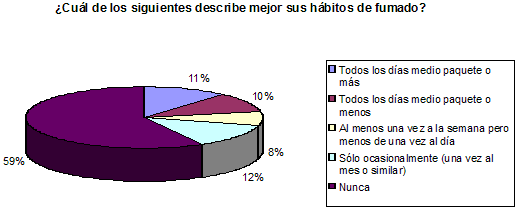
An interesting outcome is that there is a significant difference between smoking habits of men and women, because 44% of interviewed men said that they smoke occasionally while in the case of women only 39% said that they smoked occasionally. The following chart describes deeply this data, showing the few differences between men and women. Most o the women considered themselves social and occasional smokers.
Every day
half package or more |
Every day
half package or less |
At least once
a week but less than once a day |
Occasionally
(approximately once a month) |
|
| Men | 29% |
29% |
21% |
21% |
| Women | 25% |
20% |
15% |
40% |
On the other hand 83% of interviewed people that smoked ever day was 25 years old or younger, evidencing the tendency that smoking is a frequent habit in young people to great extent. The favourite places to smoke are: university 35% of the cases, restaurants, bars, and parties 28%, home 22% and other places 15%.
Certainly a great percentage of students from ULACIT (and probably from all the universities) smoke in the campus affecting the rest of their classmates. Some of the r4esults of this study showed that 62% of the non smokers feel highly affected by the students who smoke while 38% is less affected or not affected at all.
According to the interviews the majority of smokers are aware of the negative consequences that hey bring about to the non smokers. When we asked them to what extent they believed that the smoke affects non smokers around them, from 0 to 5 considering 0 the minimum and 5 the maximum, 53% answered 5, 79% answered 4 or 5 while 7% answered 2 or less.
Is there something positive?
Yes, one of the more interesting results of this study was that when we asked the interviewed people if they would like to stop smoking 86% answered yes and 82% of them, who smoked every day and 100% of the ones that smoked occasionally wanted to stop smoking. In Addition 70% of interviewed people said that they had tried to stop smoking at least once however they failed and they continued smoking. 77% of smokers were willing to receive voluntarily some kind of help from the university to stop smoking. 98% of non smokers agreed that the university could provide help to students to stop smoking.
ULACIT is a well known institution due to its good name, in addition it is an organization highly interested in human promotion as well as in promoting a greater quality life to its students and to the country in general. Why couldn’t ULACIT implement some program to help all these students to quit this harmful habit?
The best part in that students are willing to stop smoking and the university may have some resources to achieve that goal. How to achieve in the best way and at the less possible cost could be the objective for another study however, it is not so difficult. It would be important to prohibit smoking in the lobbies and other areas and to restrict to great extent the smoking areas but this is a partial solution because they still can freely smoke out of the campus. Recently ULACIT has been providing psychological assistance to students which may represent another option by a similar system the university could make groups and through conferences and different techniques help smoking and non smoking students to breathe cleaner air.
Works consulted:
- Parkin, Michael. Microeconomía. Versión para Latinoamérica. – 5ª. ed.- México: Pearson Education, 2001.
- Case, Karl E. Principios de microeconomía. – 4ª. ed.- México: Prentice Hall Hispanoamericana, 1997.
- Miller, Roger. Microeconomía Moderna. - 7ª. ed. – México: Harla, 1995.
- Nicholson. Microeconomia Intermedia. - 8ª. ed. – Bogotá: McGraw Hill, 2001.
- Valdés, Nathalie. Sánchez, Sara. El tabaco y las adolescentes: tendencias actuales. Washington D.C., Organización Panamericana de la Salud, 1999.
- Azqueta, Diego. Valoración económica de la calidad ambiental. Madrid: McGraw Hill, 1994.
- Página de Internet Cruzada en contra del fumado del IAFA: http://www.ccss.sa.cr/fumado/artic2.htm, 21 de agosto de 2003.
-----
¿Cómo citar un artículo en línea? Según el formato APA una referencia de un artículo tomado de Internet debe incluir:
- Autor o autores.
- Año de publicación.
- Título del artículo (en cursiva).
- Fecha en que fue obtenido de Internet.
- Dirección de Internet completa de la que fue tomado.
Ejemplo:
Leandro, Gabriel (2000). El entorno de la organización. Recuperado el 15 de junio de 2004, de http://www.auladeeconomia.com/articulos5.htm